How Local Production Works Inside an Apparel Factory in Los Angeles
Follow a garment from material and pattern decisions through cutting, sewing, finishing, inspection, and the choice of the right Los Angeles production path.
Production starts before sewing
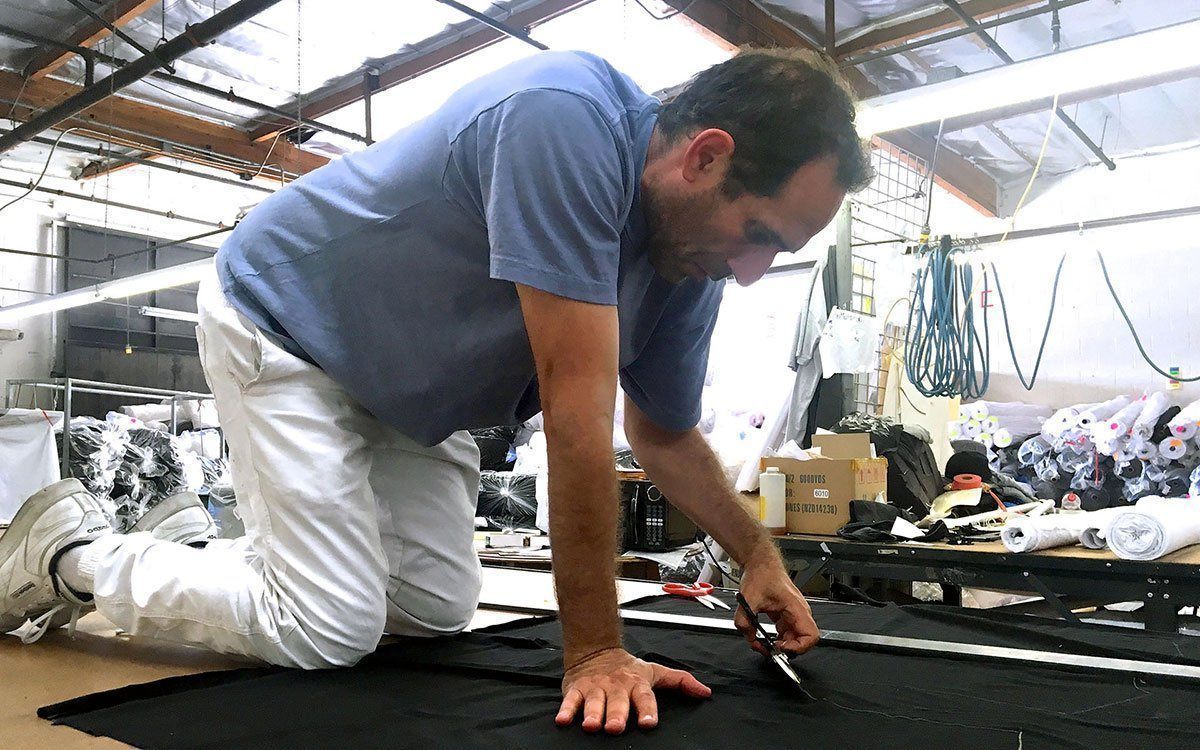 Cutting
 Knitting
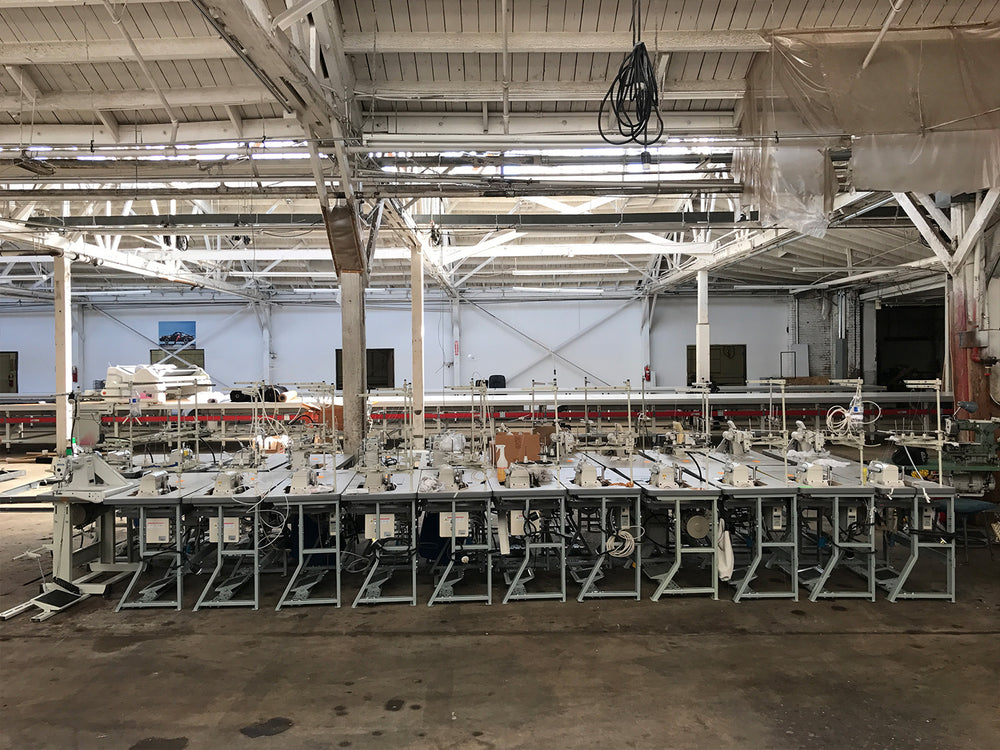 Sewing
An apparel factory in Los Angeles is not defined by one machine or one service. A garment can pass through development, fabric decisions, patternmaking, cutting, sewing, dyeing or washing, finishing, inspection, and packing before it is ready to sell. The useful question is which of those stages one company actually controls and which it sends to specialists.
That distinction matters because apparel production in Los Angeles works as an ecosystem. A development studio, sample room, cut-and-sew contractor, dye house, decorator, full-package producer, and wholesale blank supplier may all appear in a search for an apparel manufacturer in Los Angeles, but they solve different problems and enter the process at different points.
At Los Angeles Apparel, our perspective comes from making our own garments in Los Angeles and managing the relationships between fabric, pattern, cutting, sewing, dye and finish, inspection, and inventory. We look at a garment as one connected system rather than a collection of isolated features.
In this guide, we follow that system in production order, show where Los Angeles Apparel's manufacturing perspective changes the way we read the finished garment, explain the wider LA production network, and give brands or buyers a practical way to choose the right production path without treating every company in a directory as interchangeable.
Starts with
Garment + specifications
Physical production
Cutting + sewing
Finish can change
Color + hand + dimensions
Final control
Approved standard + QC
What an Apparel Factory in Los Angeles Actually Does
The word factory can make several different businesses sound more alike than they are. One operation may receive pre-cut pieces and assemble them. Another may develop the product, source materials, arrange cutting, coordinate specialty processes, inspect the goods, and pack the order.
Before comparing names, separate the service models. That makes it easier to understand what you are buying and what must already be complete.
Useful when the concept still needs technical design, patterns, prototypes, fittings, grading, or production files.
Best when patterns, materials, construction instructions, and approvals are already resolved enough to produce.
Coordinates several stages under one commercial relationship, though some operations may still be performed by partners.
Dyeing, washing, printing, embroidery, pleating, buttonholes, finishing, or another specialized process.
Removes original pattern development when a finished garment already provides the right fit, fabric, and construction.
Controls multiple linked production stages directly, making communication between textile, fit, construction, finish, and QC more immediate.
How Apparel Production Moves From Idea to Finished Garment
Apparel production is a chain of dependent decisions. A change in material can alter fit. A finish can alter dimensions. A construction choice can require a different machine or operation order. That is why approvals should happen in sequence rather than as isolated checkboxes.
Design and Product Specifications
The production team needs a reproducible definition of the garment. That can include silhouette, measurements, seam types, stitch details, fabric, trims, labels, color, finishing, size range, packaging, and acceptable tolerances.
A tech pack creates a shared reference, but it does not eliminate judgment. The factory still has to determine whether the selected material, construction, quantity, and finish can produce the intended garment consistently.
Production check: can another qualified team reproduce the approved garment from the information supplied?Yarn, Fabric, and Material Decisions
Fabric controls much of the garment's hand, drape, structure, stretch, recovery, warmth, opacity, and response to washing. Weight matters, but so do fiber, yarn, knit or weave, finishing, and the way the material interacts with the pattern.
Our manufacturing perspective treats textile and silhouette together. A dense jersey can support a boxier T-shirt. Rib recovery can determine whether a collar keeps its shape. Heavy fleece changes both the visual volume and the construction demands of a hoodie or sweatpant.
Factory principle: fabric is part of the fit decision, not a decorative choice added afterward.Patterns, Samples, and Fit Approval
A pattern converts the design into shapes that can be cut and assembled. A sample shows what those shapes do in real fabric. Fit approval should look at relationships: shoulder position, sleeve shape, body width, body length, neckline, rise, leg line, ease, and how the garment moves.
If the finished product will be washed, dyed, or otherwise processed, the approval standard should reflect that final condition when the process can change dimensions or hand feel. A beautiful pre-finish sample is not enough if the customer receives something materially different afterward.
Production check: approve the garment in the state in which it will actually be sold.Markers, Spreading, and Cutting
A marker arranges pattern pieces across the available fabric width. The layout has to use material efficiently while respecting grain, nap, stripes, direction, or other placement requirements.
Fabric is spread in controlled layers and cut into garment components. Accuracy here matters because a small shift can become a seam-alignment or measurement problem across an entire run. Cutting is where an approved pattern becomes physical production inventory.
Factory principle: a sewing line cannot correct a systematically miscut bundle without changing time, cost, or fit.Sewing and Assembly
Cut components move through an operation sequence. The machines and seams depend on the product. A jersey T-shirt, heavy fleece hoodie, work pant, swimsuit, and lined jacket do not ask the sewing floor to solve the same problems.
Sewing quality is more than a straight-looking stitch. Seam choice, allowance, stitch balance, tension, reinforcement, and operator handling affect how the garment sits and how it performs at stress points.
Production check: ask for examples with similar fabric behavior and construction, not merely a similar category name.Dyeing, Washing, and Finishing
Color can be introduced at different stages, and the chosen route changes the appearance, planning, hand, and risk. Garment dye colors a sewn garment, which means the completed piece goes through a controlled wet process before sale.
Our 1801 Garment Dye T-Shirt uses 6.5-ounce 100% U.S. cotton and is described as virtually shrink-free as a result of the garment-dye process. The important manufacturing lesson is broader than one product: color, fiber, thread, trims, chemistry, temperature, load conditions, hand, and finished measurements have to be considered together.
Factory principle: finishing is a production stage, not a cosmetic afterthought.Quality Control, Packing, and Distribution
Finished goods should be compared with an approved standard. Checks can cover measurements, stitching, shade, holes, stains, trims, labels, finishing, pressing, folding, packing, and final count.
“Good quality” is too vague to inspect. An approved sample, measurement tolerance, construction requirement, color standard, and packing specification create something a production team can actually check and repeat.
Production check: define the pass/fail standard before bulk production starts.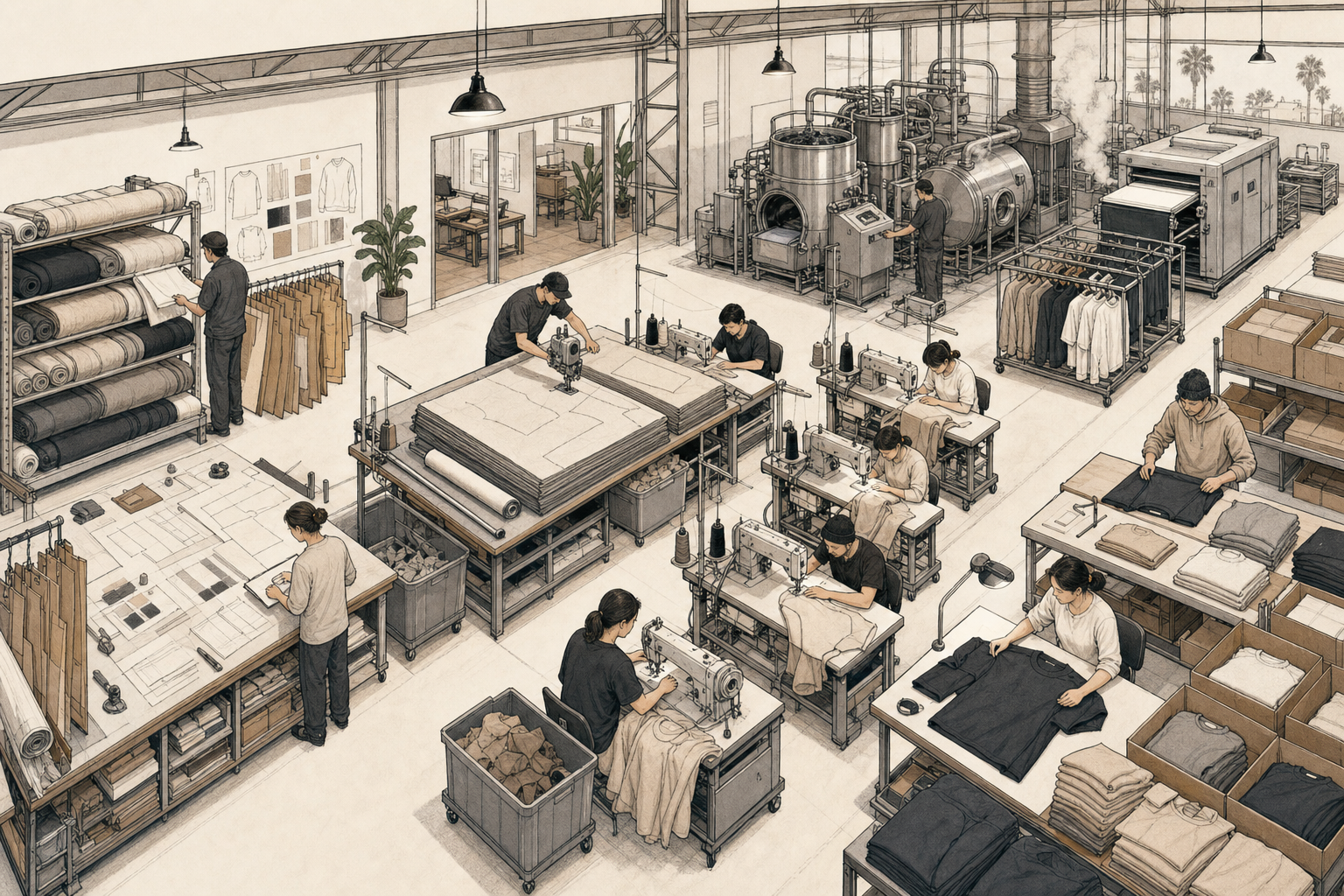
What Connected Production Changes
The advantage of seeing several stages together is not that every garment becomes simple. It is that the cause-and-effect relationships become easier to see. A fabric issue can become a cutting issue. A cutting issue can become a seam issue. A finish can alter the measurements that were approved earlier.
That is the lens we use when we evaluate our own garments: fabric, pattern, construction, dye or wash, and final dimensions have to resolve into one usable product.
When teams can see what happened before and what comes next, corrections are less likely to become disconnected instructions passed between vendors.
Textile weight, recovery, drape, body width, collar shape, seams, and finish can be evaluated as a garment system rather than a sequence of isolated specifications.
The garment the customer receives is the standard that matters. Wet processing, finishing, or pressing should be considered before the final fit is approved.
A twisted body, weak neckline, shade problem, or inconsistent measurement may begin before final inspection. Good QC looks backward as well as forward.
The 1801 as a Production Case Study
Our 1801 garment dye tees are useful here because they make several production decisions visible in a garment that appears simple. The 6.5-ounce cotton jersey gives the body more structure than a lightweight promotional tee. The high-rib crew neck changes the neckline visually and relies on the rib's recovery. The generous fit changes how the fabric hangs.
Garment dye then affects the final surface and puts the sewn shirt through its wet process before the customer receives it. None of those characteristics should be evaluated alone. The shirt works because material, pattern, collar construction, sewing, color, and final measurements resolve together.
The Wider Los Angeles Production Ecosystem
Los Angeles apparel production extends beyond one Fashion District block or one kind of factory. Downtown is strong for technical development, sourcing, patterns, samples, showrooms, and production management. South Los Angeles and Huntington Park include larger production, warehouse, knit, workwear, and cut-and-sew operations. Vernon and other industrial areas add more specialized production space.
The geography matters, but capability matters more. A business can have a Downtown office and a production floor somewhere else. Another can operate an owned factory outside the City of Los Angeles. The useful question is where each quoted stage will happen and who is responsible for it.
Los Angeles Production Businesses at a Glance
The businesses below represent different paths through the local apparel ecosystem. They are not ranked as if they offer the same service. Use the table to identify the service model that matches the stage of your project, then confirm current minimums, capacity, appointment rules, and production locations directly.
Swipe or scroll to compare →
| Business | Useful for | Service model | Verified local footprint / next step |
|---|---|---|---|
| Los Angeles Apparel | Production-ready basics, wholesale garments, and a vertically connected manufacturing reference point. | Branded manufacturing plus retail and wholesale. | South Central Los Angeles manufacturing; explore our manufacturing and wholesale paths online. |
| The Evans Group (TEG) | High-touch development, intricate garments, and smaller studio-level production. | Development studio with production support. | Arts District — 1321 Palmetto St; inquire before visiting. |
| Bomme Studio | Brands comparing CMT, full-package, private-label, and merchandise programs. | Managed production with several service paths. | South Broadway — 3480 S Broadway; submit the appropriate inquiry. |
| Lefty Production Co. | Broad apparel, accessory, leather, bag, and sewn-product development. | Development through production. | DTLA — 318 W 9th St, Suite 1010; appointment-led. |
| Renaissance Creative Studios | Development, samples, specialty materials, and smaller production runs. | Design and sewing studio. | Fashion District — 840 Santee St, Suite 604; contact first. |
| Rule Design & Development | Advisory, development, and defined small-batch manufacturing support. | Development-led studio. | DTLA — 117 W 9th St, Suite 1225. |
| Make It LA | Brands that want modular services or a fuller path from development through packing. | Full-package and custom-service production. | Fashion District — 1220 Maple Ave; appointments. |
| Argus Apparel | Common apparel categories, private label, and custom cut-and-sew support. | Custom and private-label production. | DTLA — 200 W 8th St; project inquiry. |
| 9B Apparel | Workwear, denim, fleece, knits, stretch and technical woven programs. | Factory network with development services. | Huntington Park — 2628 E 54th St; contact first. |
| ARGYLE Haus of Apparel | Structured technical development, fit-sensitive categories, and owned-facility production. | Integrated design, development, and manufacturing. | San Fernando factory — 429 Jessie St; consultation first. |
Services, minimums, capacity, appointment rules, and production locations can change. Confirm the current scope with each company before sending materials, planning a visit, or paying a development or production deposit.
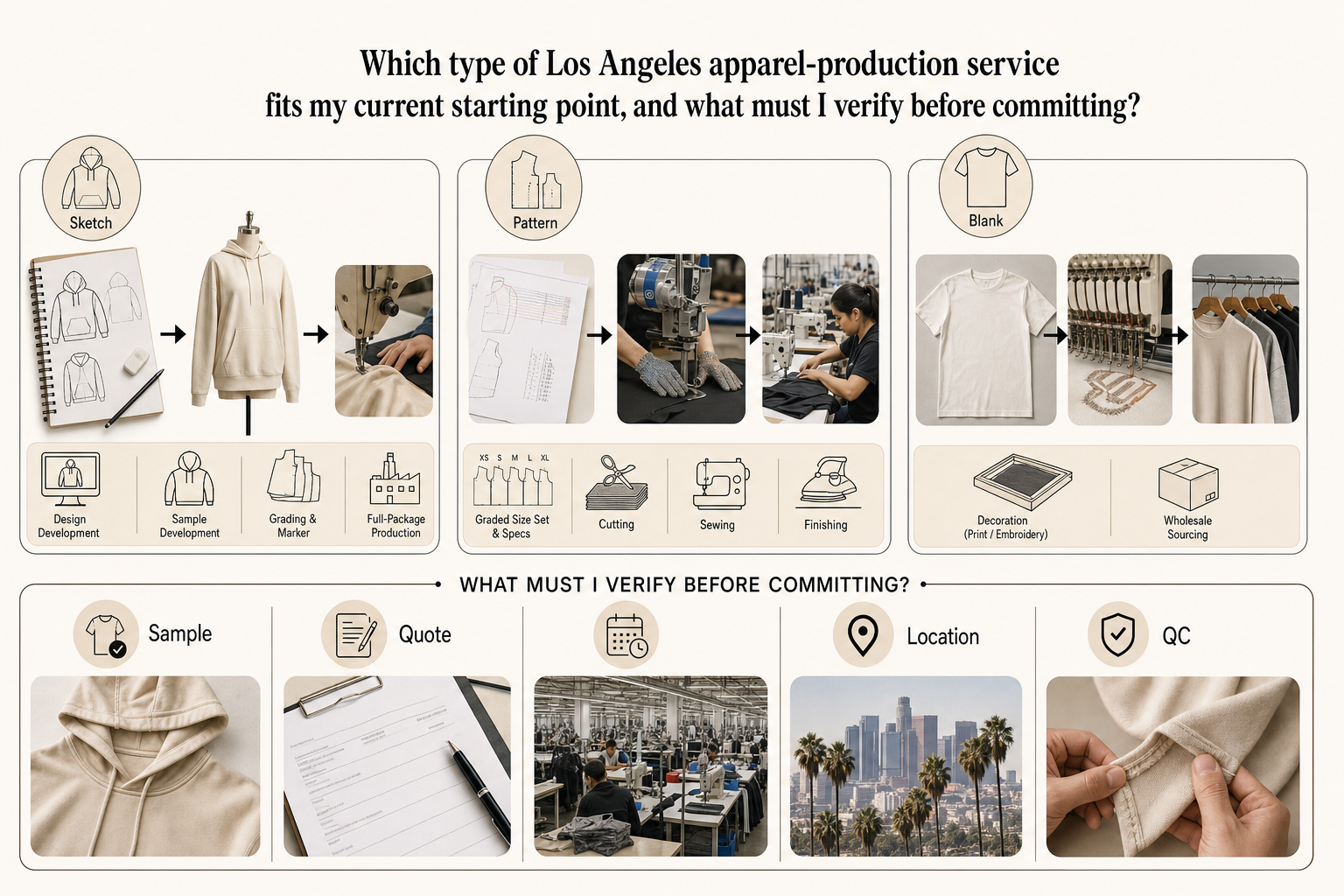
How to Choose an Apparel Manufacturer in Los Angeles
The right apparel manufacturer in Los Angeles depends on the garment, development stage, quantity, required services, and who will own each open decision. Compare providers only after those facts are clear.
Match the Service to Your Starting Point
If you have only an idea or sketch, you may need technical design, a pattern, sourcing, sampling, fitting, grading, and production preparation before bulk work is realistic. If the pattern, graded sizes, materials, and approved construction are already complete, a CMT or cut-and-sew relationship may be enough.
If an existing garment already solves the fit and fabric problem, a wholesale blank can remove months of development and reduce the number of variables you need to control.
Ask What Happens In-House
Use “in-house” as a specific question, not a marketing phrase. Ask separately about technical design, patterns, samples, grading, marking, cutting, sewing, dyeing, washing, printing, embroidery, pressing, inspection, packing, and fulfillment.
Outsourcing is not automatically a weakness. Los Angeles has strong specialist contractors. The important point is transparency: who selects the specialist, who approves tests, where goods move, who checks counts, and who is responsible if the specialist process damages the garment.
Approve a Physical Production Standard
Do not approve bulk production from photos alone when fit, fabric, color, or construction matters. Review a physical sample or another clearly documented production standard. Record its measurements, fabric, trims, stitch details, labels, color, wash, and finishing.
If the production fabric or finish changes, decide whether another approval is necessary. A production sample is useful only when it represents the product you are actually ordering.
Compare Scope Before Unit Price
A low unit price may exclude development, grading, markers, fabric, trims, special processes, inspection, packing, or freight. A higher quote may include several of those items. Put every quote into the same cost structure before deciding.
Confirm minimums by style and color, not only a total program quantity. Ask what triggers a new setup, how size or color splits affect the quote, and which approvals can pause the timeline.
Verify Registration and the Production Location
California requires people engaged in garment manufacturing to register with the Labor Commissioner. Use the California Labor Commissioner garment manufacturer and contractor resources to check the legal entity and current registration information.
Match the legal business name and address to your quote or contract. If subcontractors will be used, ask which legal businesses will handle cutting, sewing, dyeing, decoration, finishing, or packing and where those stages will occur.
How to Read the Finished Garment
A finished garment is the combined result of every earlier stage. Whether you are approving production or simply comparing clothes as a customer, the same physical checks can tell you more than a broad “quality” label.
Feel the fabric, watch how it hangs, and test only the areas designed to stretch. See whether rib, elastic, or jersey returns cleanly.
Underarms, pocket corners, crotch seams, waistbands, zipper ends, collars, and other loaded areas reveal whether construction suits the use.
For washed or garment-dyed goods, compare the finished piece with the approved post-process standard under consistent conditions.
A raw edge can be deliberate. A loose thread that allows a seam to unravel is not. A heavy fabric is not automatically better than a light one. The right test is whether the material and construction support the intended silhouette, movement, care, and repeat use.
What Working With Los Angeles Apparel Means
Our public retail and wholesale channels are built around garments we manufacture and distribute. We do not present Los Angeles Apparel as an open full-package development studio for outside custom patterns.
If an existing garment fits the program, our wholesale path can be useful for printing, embroidery, merchandise, uniforms, relabeling, or retail programs. If you need an original silhouette developed from a sketch, choose a provider that explicitly offers technical development, patternmaking, sampling, and the production model your project requires.
If you want to understand our manufacturing point of view before deciding, start with our manufacturing overview, then use the 1801 construction story as a practical example of how fabric, fit, collar, sewing, dye, and finished dimensions meet in one garment.
Frequently Asked Questions
What does an apparel factory in Los Angeles do?
An apparel factory turns materials and production specifications into repeatable finished garments. Depending on the operation, that may include fabric development, patterns, sampling, cutting, sewing, dyeing, washing, decoration, finishing, inspection, packing, or only a subset of those stages. Confirm the exact scope instead of assuming every factory offers full-package production.
Is an apparel manufacturer the same as a sewing contractor?
No. In practical industry use, a sewing contractor usually performs defined production operations for another company, while a manufacturer or full-package producer may manage a broader part of the production relationship. The terms can be used loosely, so ask what the company expects you to supply and what it will actually perform or manage.
Does Los Angeles Apparel manufacture clothing in Los Angeles?
Yes. Our manufacturing perspective and current public materials are built around Los Angeles production. We manage core stages behind our own garments and use that direct visibility to evaluate fabric, pattern, cutting, sewing, dye and finish, inspection, and the final product as connected decisions.
Is Los Angeles Apparel a custom clothing manufacturer?
Our public retail and wholesale channels are centered on garments we manufacture and distribute. We do not present our retail site as an open custom cut-and-sew or full-package development service for outside brands. Businesses that need original patterns and custom development should choose a provider that explicitly offers those services.
What is a full-package apparel manufacturer?
A full-package producer manages several stages from development toward finished production. The scope may include technical design, sourcing, patterns, samples, grading, cutting, sewing, special processes, quality control, packing, and delivery. “Full package” does not guarantee that every operation is owned in-house, so ask which stages are subcontracted.
How can I verify a California garment manufacturer?
Ask for the legal entity and any doing-business-as name, then use the California Labor Commissioner garment registration resources to check the record. Match the result to the quote, address, and production role. Also verify where work will happen, which subcontractors may touch the order, and how samples and quality standards will be approved.
Are most Los Angeles clothing factories in the Fashion District?
No. Downtown and the Fashion District are important for sourcing, development, showrooms, samples, and production management, but the wider apparel ecosystem reaches South Los Angeles, Huntington Park, Vernon, San Fernando, and other industrial areas. Always distinguish the meeting address from the actual production location.
Understand the Process Before You Choose the Factory
The most useful apparel manufacturer is not simply the first business in a local list. Start with the garment. Define what is already complete. Identify the production stages still unresolved. Then compare companies whose real equipment, people, workflow, and commercial model fit that work.
Local production can make communication, sample review, and problem-solving more direct, but proximity does not replace documentation. An approved sample, measurable specification, clear scope, verified production chain, and defined quality standard are what turn an idea into repeatable production.
From our position inside Los Angeles apparel manufacturing, the strongest garments are the ones in which fabric, fit, construction, finish, and final measurements agree with each other. That is the standard worth carrying from the first sample all the way to the finished product.