How to Choose a String Bikini: Coverage, Fit, Ties & Sizing
A practical guide to choosing the right top shape, bottom coverage, tie placement, size, and material before you build your set.
FIT AT A GLANCE
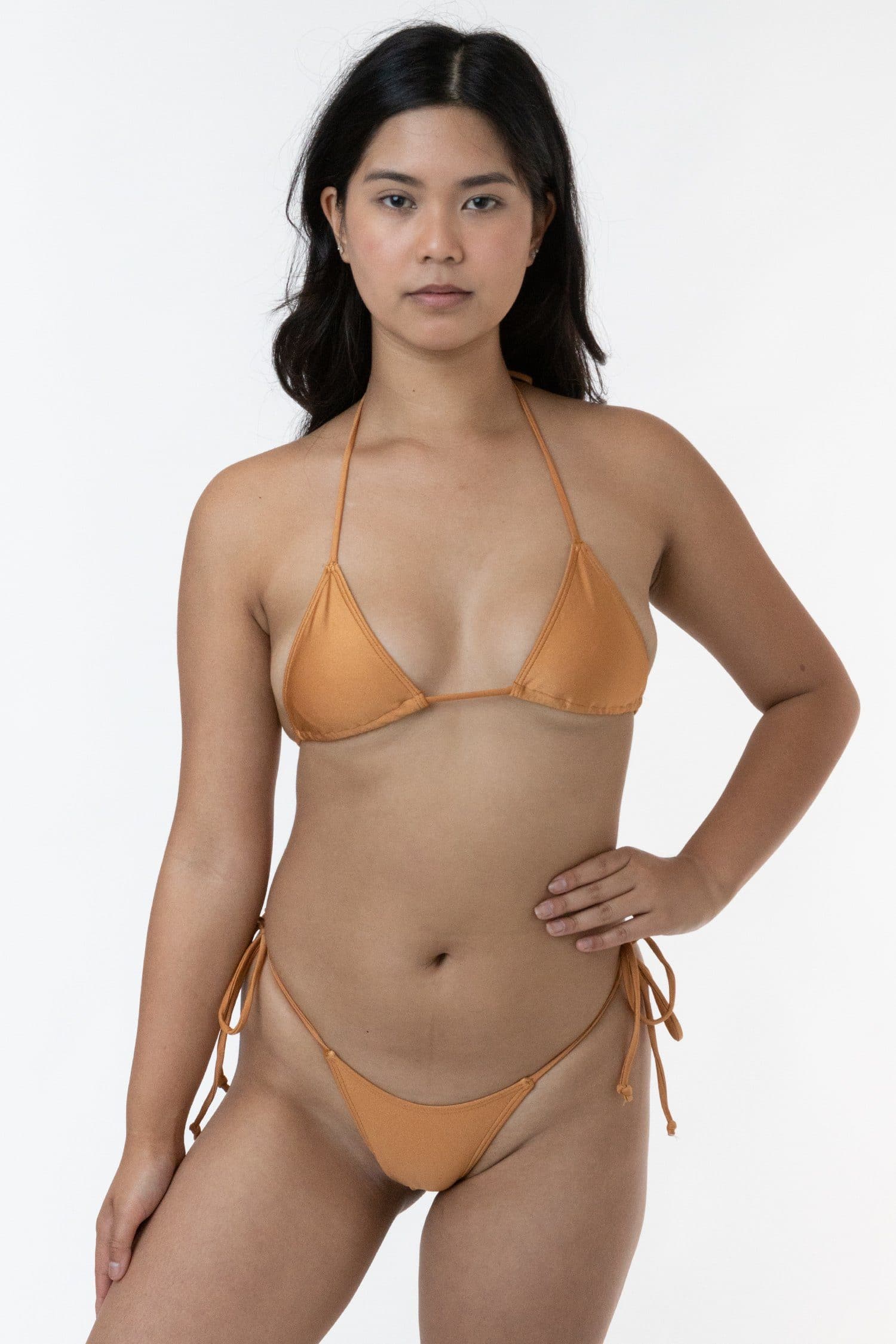
A string bikini is defined more by its narrow ties and adjustable construction than by one fixed amount of coverage. A classic triangle top, halter top, micro triangle, traditional tie-side bottom, thong, and G-string can all use string construction while covering very different amounts of the body.
That distinction matters when you are shopping. The word string tells you how much of the garment is adjusted with ties; it does not automatically tell you whether the top is micro, whether the bottom is a thong, or how high the sides will sit on the hip.
At Los Angeles Apparel, our string-bikini assortment ranges from adjustable nylon-tricot classics to a more covered halter, micro nylon styles, metallic Lamé pieces, and leather fashion pieces. Because these products are sold as separate tops and bottoms, you can choose the silhouette and size of each piece independently.
This guide starts with coverage, then moves through top and bottom shapes, final-sale sizing, tie placement, mix-and-match decisions, materials, and care. The goal is simple: understand what each silhouette changes before you order.
Construction
Adjustable ties
Top Range
Halter to micro
Bottom Range
Classic to G-string
How to Buy
Top + bottom separately
What Makes a Bikini a String Bikini?
The most useful way to understand the category is to separate construction from coverage. String-bikini pieces use narrow straps or ties to adjust the garment at the neck, back, or hips. Those ties can support several different shapes.
Our classic String Bikini Top, for example, ties behind the neck and back. Its longer narrow cups can be scrunched for a more revealing placement or opened for a more traditional triangle shape. Our Halter String Bikini Top also belongs to the string-bikini family, but the halter shape provides more coverage than the regular string top.
The same principle applies below the waist. Our classic tie-side bottom, thong bottom, and Micro G-String all use adjustable ties, but they are not the same coverage category. The ties tell you how the garment adjusts; the front and back pattern pieces determine how much it covers.
Compare String-Bikini Top Styles
Top coverage changes with the size and shape of the cup as much as it changes with the ties. If you already know how much coverage you want, start there rather than beginning with color.
Classic starting point
Classic Triangle
Longer narrow cups, adjustable neck and back ties, and scrunchable coverage.
Shop classic →More coverage
Halter
A narrow halter shape that covers more than our regular string top and can also be configured as a classic triangle.
Shop halter →Minimal
Micro Triangle
A smaller triangle direction for shoppers intentionally looking for very little top coverage.
Shop micro →
Adjustable neck and back ties with scrunchable coverage.Shop the style →
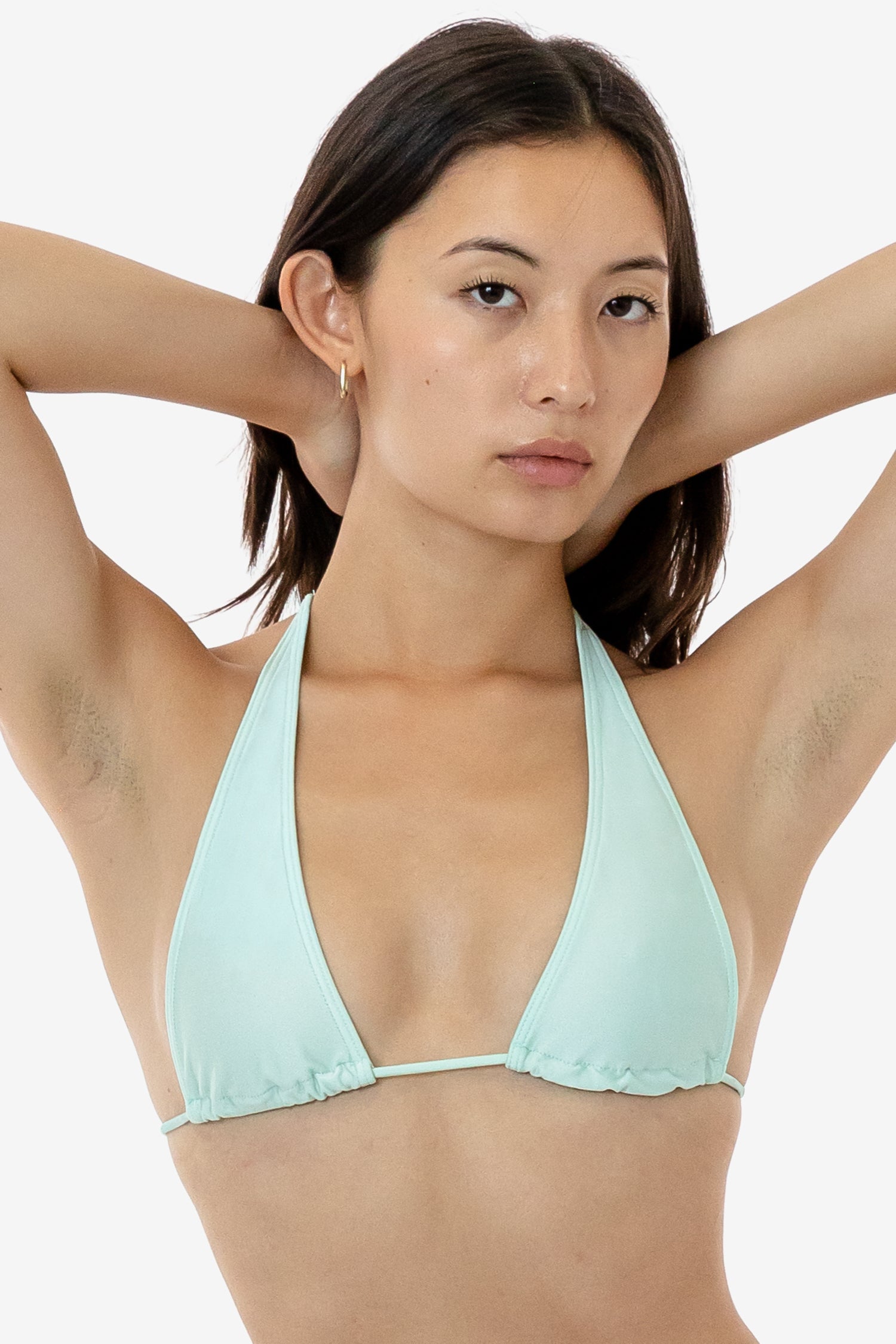
More coverage than the regular string top while staying adjustable.Shop the style →

A smaller cup scale with adjustable neck and back ties.Shop the style →
| Top Style | Coverage Direction | Adjustment | What Changes |
|---|---|---|---|
| Classic String Bikini Top | Adjustable classic triangle | Neck + back ties; scrunchable cups | Traditional starting point with control over cup placement. |
| Halter String Bikini Top | More cup coverage | Halter configuration; can also be worn as a classic triangle | Useful when you want to remain in the string-bikini family without choosing the smallest top shape. |
| Nylon Tricot Micro Triangle Top | Barely-there coverage | Neck + back ties | Reduces the scale of the cup itself, not just the width of the straps. |
| Lamé Micro Triangle Top | Micro | Neck + back ties; scrunchable cups | Adds a metallic Lamé surface to the micro silhouette. |
Classic Triangle: Adjustable Coverage Without Changing the Basic Shape
The classic triangle is the easiest place to start when you want a recognizable string-bikini shape. On our RNT3003, the cups are longer and narrow, the straps tie behind the neck and back, and the cups can be scrunched along the string. That means you can change how the fabric sits without changing to an entirely different neckline.
Halter: More Coverage in the Same Adjustable Family
The halter is the more-coverage option in our current string-top range. The shape stays narrow, but the top provides more coverage than our regular string bikini top and can be configured in more than one way. If a micro or classic triangle feels too exposed, this is the comparison to make first.
Micro Triangle: Smaller Panels, Not Just Thinner Ties
A micro top changes the scale of the fabric panels themselves. Our Nylon Tricot Micro Triangle Top is intentionally described as barely-there coverage, while our Lamé Micro Triangle Top combines a micro fit with adjustable ties and scrunchable cups. Choose these because you want a smaller coverage area—not because every string top is automatically micro.
Compare String-Bikini Bottom Coverage
Bottom terminology becomes clearer when you ask two separate questions: how much does the back cover? and how much fabric sits across the front? Rise and side-tie placement change the look again, but they do not turn a classic bottom into a thong or a thong into a G-string.
| Bottom Style | Coverage | Adjustment | Best Starting Point |
|---|---|---|---|
| String Bikini Bottom | More traditional string-bikini coverage | Side ties; higher-rise direction | Start here when you want an adjustable tie-side bottom without moving directly to thong coverage. |
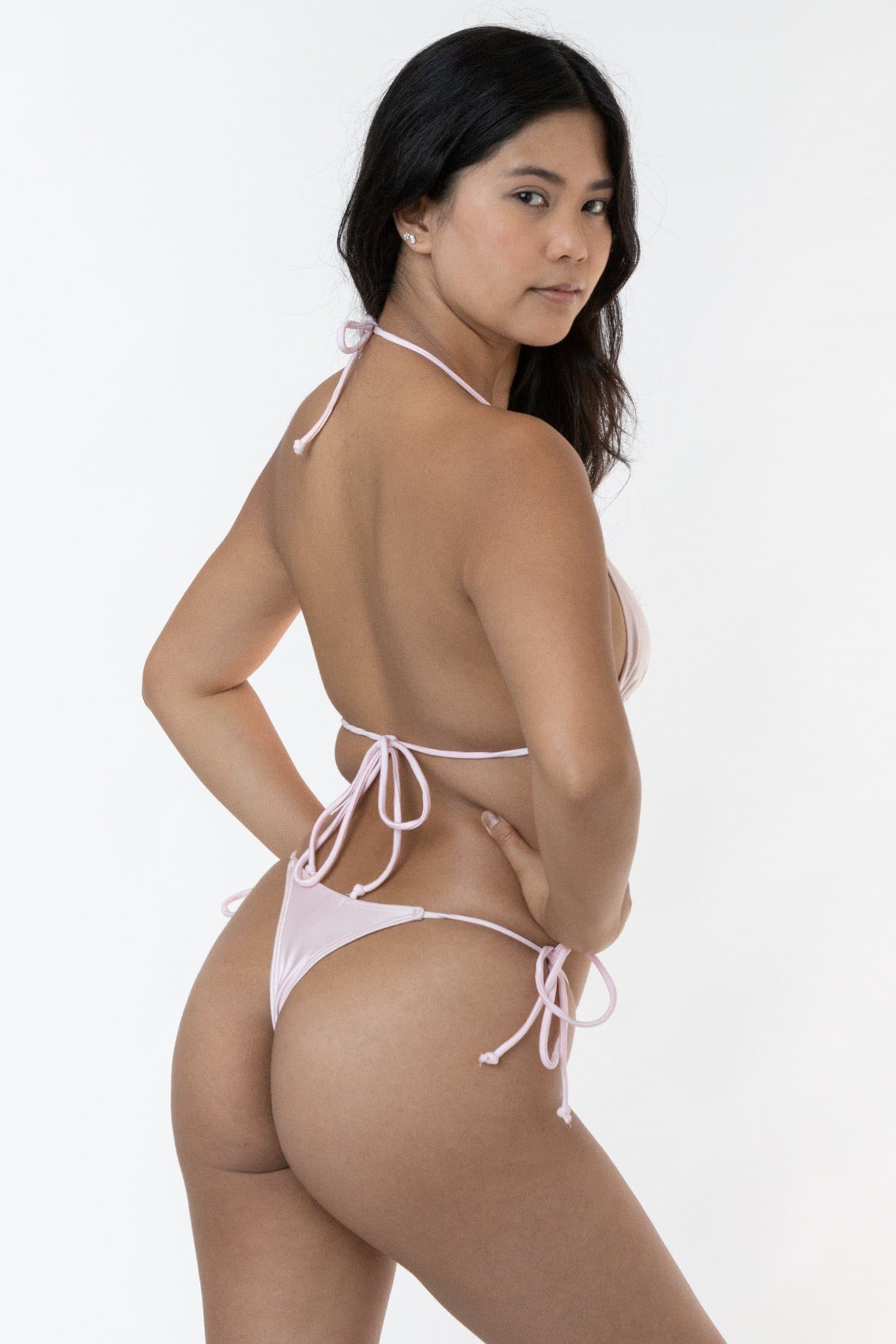
| Thong String Bikini Bottom | Minimal front + rear coverage | Side ties; low-cut front; can be tied higher on the hips | Choose when minimal rear coverage is the point. |
| Nylon Tricot Micro G-String | G-string | Adjustable hip ties | The least-coverage direction in this nylon-tricot group. |
| Lamé Low Rise String Bottom | Minimal, low rise | Side ties | For a metallic finish with a low-rise string silhouette. |
| Lamé V-Cut Thong | Micro thong | Side ties; V-cut front and back | For minimal coverage plus the metallic Lamé surface. |
How to Choose Your Size When the Bikini Is Final Sale
Final-sale swimwear rewards a slower sizing decision. Adjustable ties can change position and tension, but they do not make every cup or bottom panel the same size. Start with the actual product information, then decide whether your goal is more or less coverage.
01Start With the Product Size Chart
Use the size chart attached to the exact style rather than assuming one string-bikini size behaves identically across classic, halter, micro, nylon, printed, and Lamé pieces.
02Compare the Model Reference
Model height, measurements when provided, and the worn size give you another point of reference. They are not a substitute for your own measurements, but they help show how the intended amount of coverage looks on a real body.
03Decide How Much Coverage You Actually Want
Two shoppers with similar measurements can still want different sizes if one wants a micro placement and the other wants more frontal or cup coverage. Make that decision before you interpret the size chart.
04Follow Product-Specific Sizing Notes
Do not apply one universal “size up” rule. Our RNT3002 Thong String Bikini Bottom specifically advises sizing up when you want more frontal coverage. Our Lamé V-Cut Thong carries the same type of product-specific guidance. That does not mean every string-bikini top or bottom should automatically be sized up.
05Choose the Top and Bottom Independently
If your preferred top size and bottom size are different, use them. A matching set does not require matching size labels, and separate sizing is one of the practical advantages of building a string-bikini set from individual pieces.
06Tie It Where You Will Actually Wear It
A bottom tied high on the hip can look and feel different from the same piece worn lower. A triangle cup pulled wide can cover differently from the same cup scrunched narrower. Judge the garment in the position you intend to use.
07Check Movement Before You Commit to the Fit
Once the ties are secure, sit, bend, raise your arms, and move through the positions you would normally use. You are checking whether the coverage stays where you expect it to—not whether the ties can simply be pulled tighter.

How to Tie and Position a String Bikini
String construction lets you fine-tune where a garment sits. The most secure fit is not automatically the tightest possible knot; it is the position where the garment stays balanced without pulling the fabric out of shape.
Neck and Back Ties
On triangle and micro tops, adjust cup position before you fully tighten the neck. Then use the back tie to set the band tension. If the neck is doing all the work, the top can feel unnecessarily tight even when the cups are not positioned correctly.
Scrunchable Cups
On styles with scrunchable cups, moving the fabric along the string changes the width of the cup. Narrower placement exposes more; spreading the fabric creates a more traditional triangle presentation. Make the adjustment symmetrically, then reassess coverage once the top is tied.
Side-Tie Bottoms
Set the front and back panels first, then tie the sides at the same general height. Our classic and thong string bottoms can be worn higher on the hips, but moving the ties upward also changes the angle of the leg line and how the front panel sits.
Secure Knots
Tie a knot that stays stable under normal movement and test it before swimming or wearing the garment for a full day. If a tie needs extreme tension to stay in position, recheck the size and placement rather than relying only on a tighter knot.
How to Build a Mix-and-Match Set
A string-bikini set does not have to match by silhouette. In fact, separating the top and bottom decisions often creates a better fit because you can control coverage in each area independently.
Same fabric
Match the material
Keep the textile consistent while changing the amount of coverage.
Mixed coverage
More top + less bottom
Pair a halter with a thong or micro bottom when you want more cup coverage without increasing rear coverage.
Mixed coverage
Micro top + classic bottom
Reduce the top scale while keeping a more traditional tie-side bottom shape.
Color
Match or contrast
Use the same color for a set effect or separate the pieces intentionally.
Solid + printed
Let one piece carry the print while the other stays visually quieter.
Size
Choose independently
Do not force the same size on top and bottom just to create a matching set.

Classic Direction
A classic adjustable triangle top for a traditional starting point.
Shop the top →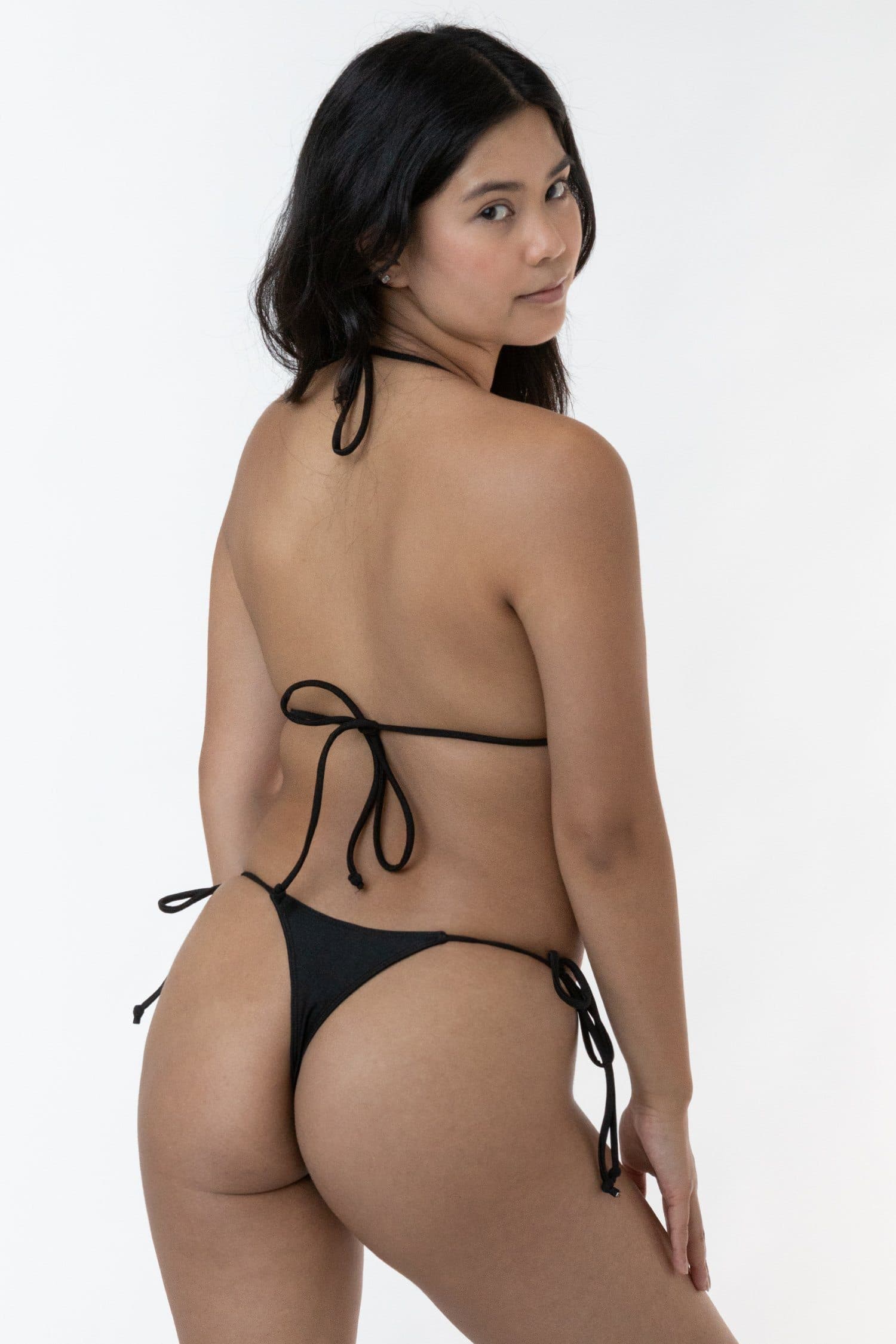
Minimal Direction
A low-cut thong bottom when minimal rear coverage is the goal.
Shop the bottom →Understand the Materials Before You Mix Them
String describes construction, not fiber content. Our current assortment includes nylon-tricot styles, printed stretch versions, metallic Stretch Lamé, and genuine leather fashion pieces. Those materials should not be treated as though they have identical hand feel, care, or water use.
| Material Direction | What It Changes | Examples | Care / Use Note |
|---|---|---|---|
| Nylon Tricot | Smooth stretch and the classic swim direction in this assortment. | RNT3003, RNT3004, RNT3002, RNT003, RNT023 | Current product pages for these styles state machine washable; follow the specific garment label. |
| Printed Stretch | Changes the surface design while retaining adjustable swim construction. | Printed Halter String Bikini Top | The current printed halter is 80% polyester / 20% elastane and machine washable. |
| Stretch Lamé | Adds a shiny metallic surface to micro and low-rise silhouettes. | RLA3033, RLA3034, RLA3032 | Use the sewn-in care label; do not transfer the nylon-tricot washing rule automatically. |
| Genuine Leather | Turns the bikini silhouette into a fashion piece with a leather surface and cotton lining. | RLH3436, RLH3437 | Dry clean only and not water resistant. |

Smooth stretch and the classic swim direction.Shop nylon →
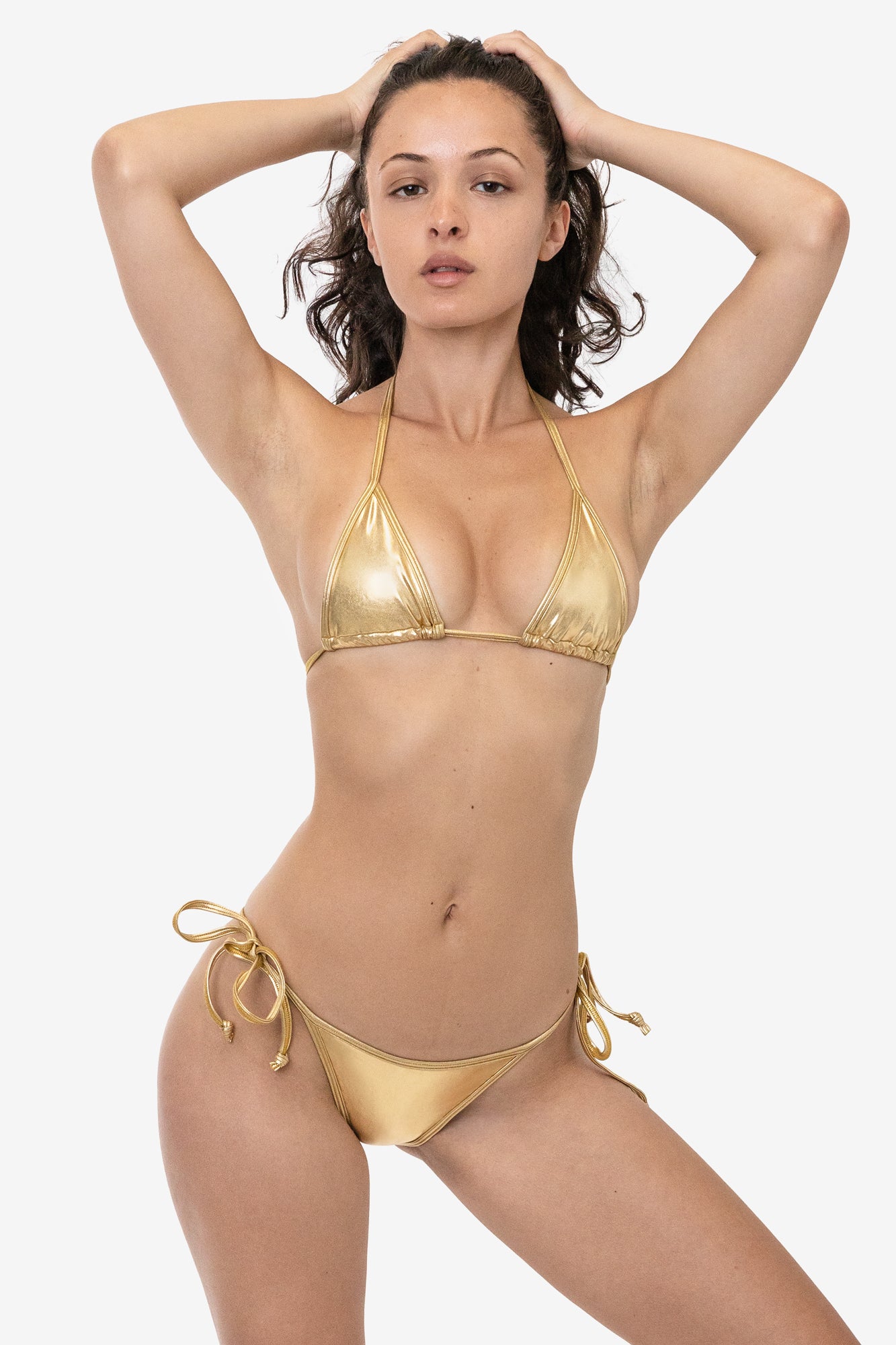
A metallic surface with a low-rise string silhouette.Shop Lamé →
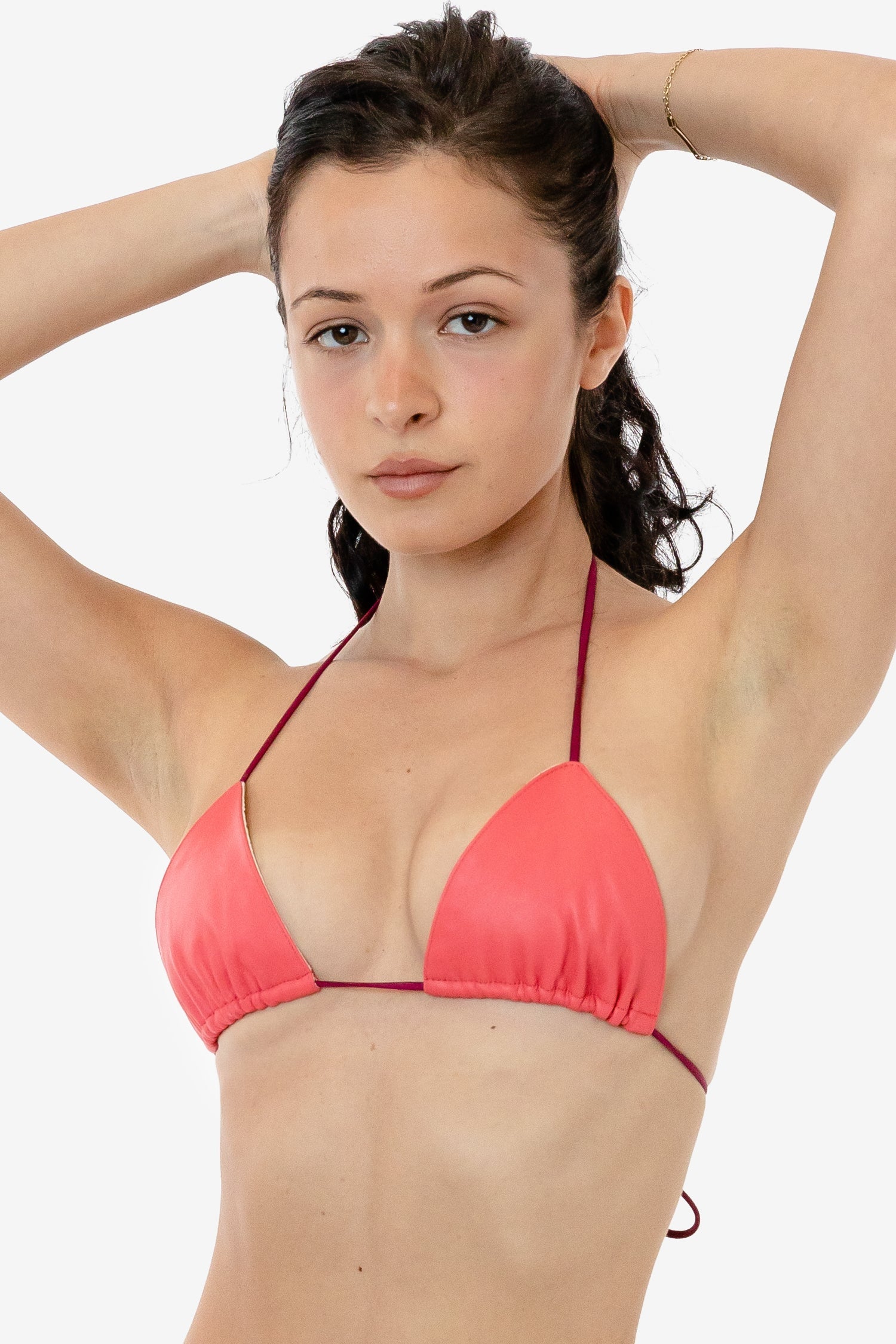
A non-water-resistant fashion interpretation of the bikini shape.Shop leather →
String Bikini vs. Thong Bikini vs. Micro Bikini
These words describe different things, which is why they can overlap on the same garment. Once you separate construction, neckline, and coverage, the names become much easier to understand.
| Term | Usually Describes | Coverage Implication | Can Overlap With |
|---|---|---|---|
| String bikini | Narrow or tie construction | Can range from more traditional to very minimal | Triangle, halter, thong, G-string, micro |
| Thong bikini | Rear coverage shape | Minimal rear coverage | String side ties, low rise, V-cut |
| G-string | Very narrow rear construction | Least rear coverage in this comparison | Micro scale, adjustable hip ties |
| Micro bikini | Overall scale of the fabric panels | Very minimal top or bottom coverage | Triangle, thong, G-string |
| Halter bikini | Top neckline and support shape | Can provide more cup coverage | String construction, triangle configuration |
How to Care for a String Bikini
Start with the sewn-in care label on the exact garment. The collection spans different fibers and finishes, so one rule should not be transferred automatically from nylon tricot to printed polyester, Lamé, or leather.
Our current classic nylon-tricot top, classic bottom, thong bottom, Micro Triangle Top, and Micro G-String product pages state that those pieces are machine washable. The printed halter is also listed as machine washable, but its fabric is a polyester-elastane blend rather than the nylon-elastane composition of the solid halter.
For Lamé, follow the exact garment label rather than assuming it should be washed exactly like the nylon pieces. For our leather bikini pieces, the rule is completely different: they are dry clean only and not water resistant.
When you are building a mixed set, check both labels. A top and bottom that work visually together can still have different material and care requirements.
Frequently Asked Questions
What is a string bikini?
A string bikini uses narrow ties or string-like straps as part of its construction, commonly at the neck, back, or hips. The term does not guarantee one amount of coverage: classic triangle, halter, micro, thong, and G-string proportions can all appear within the string-bikini category.
Is a string bikini the same as a thong?
No. String describes tie or strap construction, while thong describes the rear coverage shape of a bottom. A string-bikini bottom can have more traditional rear coverage, thong coverage, or a G-string back.
Do string bikinis offer enough coverage?
They can. Coverage depends on the exact silhouette. Our halter top provides more coverage than our regular string top, while our Micro Triangle Top is intentionally designed for barely-there coverage. On the bottom, a classic tie-side style covers more than a thong or G-string direction.
Should I size up in a string bikini?
Not automatically. Use the size chart and the product-specific fit note. Our RNT3002 Thong String Bikini Bottom and RLA3032 Lamé V-Cut Thong specifically suggest sizing up if you want more frontal coverage. That guidance should not be turned into a universal rule for every string-bikini style.
Which string-bikini top offers more coverage?
Within the current Los Angeles Apparel string-top assortment, the Halter String Bikini Top is specifically described as providing more coverage than our regular String Bikini Top while keeping a narrow halter silhouette.
Can I buy different top and bottom sizes?
Yes. The tops and bottoms are sold as separate pieces, so you can choose the size and silhouette of each independently. That is useful when your preferred amount of coverage or fit differs between top and bottom.
How do I keep side ties secure?
Position the front and back panels first, keep the two sides reasonably balanced, and tie a stable knot without relying on extreme tension. Test the fit while sitting, bending, and walking so you can see whether the panels stay where you expect them to.
Can a leather string bikini be worn in water?
No. Our current leather string-bikini top and thong bottom are explicitly listed as not water resistant and dry clean only. Treat them as fashion pieces rather than ordinary swimwear.
What is the difference between a micro bikini and a string bikini?
Micro refers to the small scale of the fabric panels, while string refers to the narrow tie construction. A bikini can be both micro and string, but a string bikini does not have to be micro.
Choose the Coverage First, Then Build the Set
The easiest way to shop this category is to stop treating “string bikini” as one silhouette. Start with the top coverage you want, choose the bottom coverage separately, then use the ties to fine-tune placement and tension.
If you want a more familiar triangle direction, begin with the classic top. If you want more cup coverage, compare the halter. If the intention is a micro look, move to the Nylon Tricot or Lamé micro tops. Do the same below the waist: classic tie-side, thong, and G-string are three different coverage decisions.
Once the silhouettes are right, choose the material and color. That order makes the adjustable construction work for you rather than asking one word—string—to explain the entire fit.